
Emergency and Safety Lighting

Every building will have its own specific requirements in respect of emergency escape illumination, the role of which, as noted above, is to take over from the normal lighting provision in the event of a power or circuit failure. Of course, these levels of 'normal' lighting will vary, even within an individual building. Different areas inside will have different levels of natural illumination: for example, rooms with external windows have the benefit of daylight, while unglazed, internal areas such as corridors and stairwells must always have lighting provided.
If a building is occupied at night, there must usually be provision for emergency lighting in all areas, including those that are naturally lit during the day. One exception may be in the case of 'borrowed' light from external street lamps (switched on during the hours of occupancy of the premises): if this is a reliable source of lighting and reaches sufficiently inside the building to illuminate the escape routes, it can sometimes be considered sufficient, depending on who will be using them.


Emergency lighting systems must be installed by a competent person accredited by a professional body.
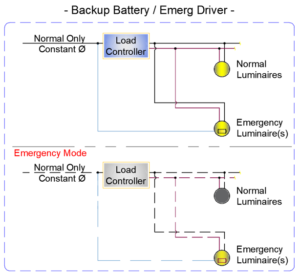
There are three modes of operation of emergency lighting;
- Non-maintained – where the emergency lamps are not energised until there is a mains failure.
- Maintained – where the emergency lamps are energised at all times.
- Sustained – where an emergency luminaire has two or more lamps, at least one of which is operated from the emergency supply, and the remaining are from the normal mains supply.
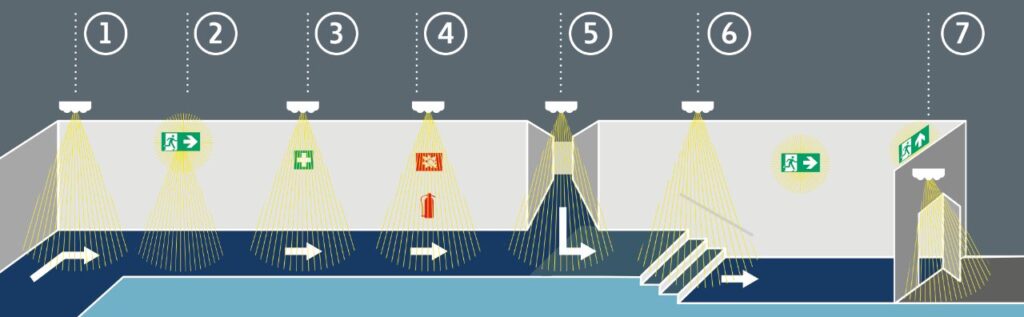
Emergency Lighting for escape routes, including external ones, must have sufficient lighting for people to see their way out safely. Emergency escape lighting may be needed if areas of the workplace are without natural daylight or are used at night. Emergency lighting needs to function not only on the complete failure of the normal lighting but also on a localised failure if that would present a hazard. Emergency escape lighting should:
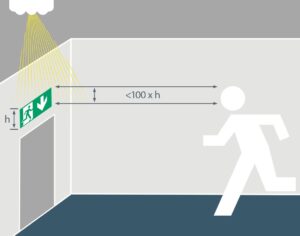
- Indicate the escape routes clearly;
- Provide illumination along escape routes to allow safe movement towards the final exits; and
- Ensure that fire alarm call points and firefighting equipment can be readily located.
 In addition to emergency escape lighting, it may be necessary to provide other forms of emergency lighting for safety reasons, for example, to ensure that manufacturing processes can be shut down safely.